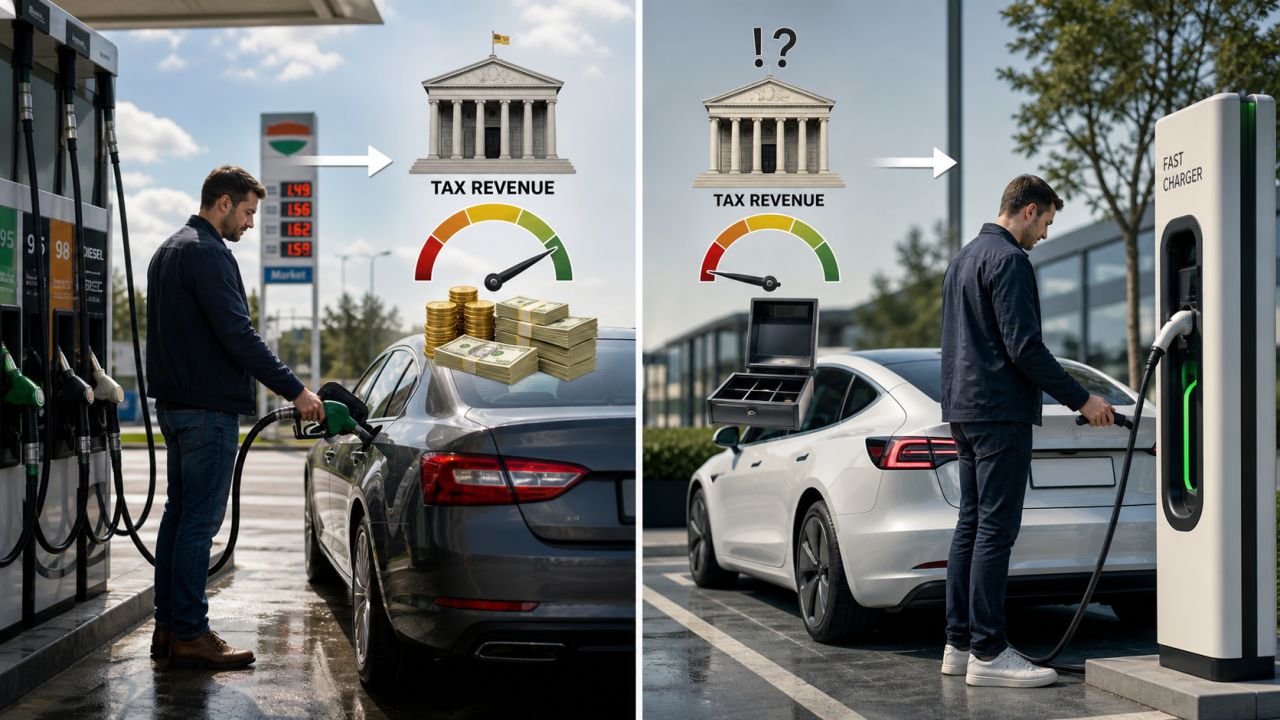
The debate around electrifying Europe's car fleet is usually framed as a question of how to make mobility cleaner.
That framing misses the other real question coming our way.
Here is the mechanism we rarely name. Pigouvian taxes rest on a double objective: discourage a harmful behaviour, and raise revenue.
But as long as those two goals point in the same direction, the tax enjoys — relatively — broad consent, because the virtuous purpose politically legitimises the levy. Fuel taxation has worked exactly this way for two decades.
However, a behavioural tax carries an internal contradiction: if it fully succeeds, it destroys its own base. And fuel taxation is about to succeed.
As the fleet, albeit slowly, electrifies, fuel tax revenues are falling across Europe, what the experts increasingly call a "fiscal black hole." The Commission's own revision of the Energy Taxation Directive is, among other things, an attempt to confront this.
So the question is no longer whether we should make the car fleet more virtuous. It is what happens once we have.
The State, having grown dependent on a revenue it built on a harmful behaviour, will have to find a new base. And the only one available is the virtuous alternative itself: distance-based road charging on the very electric vehicles we spent years subsidising.
It is already live in Iceland, under study in Switzerland, Ireland and the UK, and Norway, the EV champion, has already started taxing electric cars after car-related revenue dropped 40%.
This is where it gets politically dangerous, and the danger goes well beyond the budget.
The citizen who made the effort, who bought the (often expensive), shiny new electric car, will discover they are also being taxed for their virtue. The underlying social contract rested on the virtuous purpose of the tax; once that purpose is achieved and the tax remains, the consent collapses.
This is one of the underestimated drivers of the growing distrust toward climate or public-health policy, and of the populist backlash that feeds on it. Because the mechanism is structural rather than designed, it is easily misread as a plot, which is exactly what fuels, no pun intended, the conspiracy theories.
Many people sense, confusedly or not, that they will be taxed whatever they do, and that the justification is movable while the need for revenue is constant.
The lesson is not that these policies are illegitimate. It is that the behavioural tax is a structurally trapped instrument.
This fiscal and social deadlock can only be resolved through more efficient public spending, so that citizens feel that the levies imposed on them are being better spent, thereby strengthening output legitimacy, in lieu of justification by the tax base.
Originally published on LinkedIn, 6 June 2026.